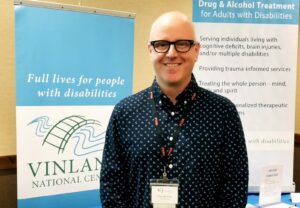
Presented by Molly Gilbert, M.Ed., director of business development at Vinland National Center in Loretto and Minneapolis, MN

Abstract:
Traumatic Brain Injury is an important public health problem in the United States. Because the problems that result from TBI, such as those of thinking and memory, are often not visible, and because awareness about TBI among the general public is limited, it is frequently referred to as the “silent epidemic”.
Marilynn Lash: The Essential Brain Injury Guide (4th Edition) The Brain Injury Alliance of America, 2007.
In this presentation, you will learn about the specialized work that Vinland National Center does within the field of substance use disorder focused on clients with brain injuries, along with common, basic identifiers to help increase identification and screening for individuals you might be working with who may suffer with a Traumatic Brain Injury (TBI). It includes information on strategies and accommodations for problem-solving challenging neurobehavioral issues. Tools to utilize when working with someone with a TBI will be shared, along with anecdotal information regarding what behaviors could potentially be related to TBI.
Much of the outreach Vinland does consists of educating those working within the fields of Substance Use Disorder (SUD), Mental Health and Corrections, regarding symptoms to be mindful of that might indicate you are working with a client with a TBI. This identification can make a preventative difference within the field of SUD and for those working with justice-involved individuals, as many TBI clients will mistakenly waive their Miranda rights, or sign documents they don’t understand, as the professional representing or working with them may not be aware of the ‘silent epidemic’ that is TBIs, especially prevalent within the SUD & justice-involved population.
We often aren’t sure which came first: the chicken or the egg, when it comes to SUD and TBIs, but we do know at least half of SUD develops after a client obtains a TBI. They realize their life is no longer what it once was – and in some cases they have become different people. The grief & loss associated with a TBI can often lead to that person turning to drugs and alcohol as a coping mechanism. We believe if we help identify that a client has a TBI, then get them the right resources, we can, in many cases, avoid a client feeling like they have no other option than to self-destruct through self-medication.
It has been estimated that upwards of 90% of justice-involved individuals have suffered medium to severe TBI’s, and that 1 in 2 people living with a brain injury has a substance abuse issue, according to the Department of Health & Human Services Office on Disability. This rate is 5 times higher than the general population. For the last 35+ years, Vinland has worked specifically with clients with Traumatic Brain Injuries and cognitive disabilities (including FAS, Fetal Alcohol Effect, Asperger’s Syndrome, Autism Spectrum Disorder and severe and persistent mental health issues), within the substance use disorder realm, in both residential and outpatient treatment settings, and is one of the only treatment centers in the country that exclusively specializes in this population.
Clinicians, social workers and court systems often aren’t aware of a specialty program until they need one. In fact, Vinland has found that there are many hospitals, clinics, other treatment centers, legislators, defense attorneys, jails and mental health facilities, who may be working with or representing people with brain injuries, aren’t aware of it. Getting this essential information to these professionals, prevents further compounding damage for individuals with TBIs going ‘through the system’, by teaching others how best to identify and remain aware of this disability. Only then can we all truly help the client get the resources they need to get better.
Bringing essential knowledge to professionals on how to help identify a TBI, only helps those clients who are not able to advocate fully for themselves, and can prevent further, often unnecessary involvement within the justice-involved arena, instead leading a client towards getting the help they need in the form of mental health care and/or SUD treatment.
Molly is often asked to present within the judicial system about the work Vinland does, and shares research articles regarding working with clients with TBI’s and the misunderstandings that often take place due to misdiagnosis. In fact, the article on perceptions of Public Defenders within the state of Minnesota has shed light onto that field, and Vinland was reached out to present at their statewide conference in Nisswa recently. We find there are many hospitals, clinics, courts, other treatment centers, legislators, jails and mental health facilities, who may be working with or representing people with brain injuries, but aren’t aware of it. Bringing essential knowledge to them on how to help identify a TBI, only helps those clients who are not able to advocate fully for themselves.
Contact mollyg@vinlandcenter.org or 763.479.4525 to schedule.


 Edwin’s OVERVIEW